
Lyon County Arrest Records and Court Charges
Lyon County arrest records are law-enforcement records tied to an arrest, booking, report, warrant service, citation, or custody event. The Lyon County Sheriff's Office is the local law-enforcement source identified in the research, but no official Lyon County Kentucky online jail roster, mugshot database, or public jail blotter was located. A court case lookup may show filed charges, but it is not a booking feed.
Court charges after arrest begin when a prosecutor, grand jury, officer citation, complaint, information, or indictment brings the accusation into court. The charge record is tracked through District Court or Circuit Court, depending on whether the matter is a misdemeanor, DUI, traffic-level criminal case, preliminary felony matter, or felony case. The full case file and final outcome belong in Lyon County criminal court records.
The Lyon County Sheriff's Office homepage is the official local source for sheriff services, contact details, and law-enforcement record routing.

That sheriff source supports the arrest-record side of the page, while the court clerk and Kentucky court tools support the filed-charge side.
How to Find Lyon County Arrest Records and Charges
Start with the type of record. For charges filed in court, use the Trial Court Docket portal, ePay where the case is payable, CourtNet where login access applies, and the Circuit Court Clerk for copies. For sheriff reports, accident reports, and responsive law-enforcement records, use the Lyon County Sheriff's Office open-records process. For custody status, Kentucky VINE and KOOL may help with state custody or notification, but they are not a county arrest database.
- Check whether the event is only an arrest, a filed court charge, or a completed criminal case.
- Use the Kentucky Trial Court Docket portal for Lyon County hearing dates tied to filed charges.
- Use ePay for payable citations, fines, fees, and party searches when payment eligibility exists.
- Contact the Circuit Court Clerk for the formal charge list, amendments, dispositions, and certified copies.
- Use the LCSO written open-records process for sheriff reports, subject to exemptions and active-investigation limits.
The sheriff's site gives a concrete records request path: a written and signed request with printed name, address, phone number, and a specific description of the records sought. Public agencies are not required to compile information or answer questions in place of producing existing records.
Charging Documents After Arrest
After an arrest, the court charge record begins through a charging document. Kentucky criminal matters may start by citation or complaint in District Court, then move differently if the case is a felony. Prosecutors decide which charges to pursue, and a grand jury indictment can place felony charges into Circuit Court. One arrest can lead to several charges, and those charges can change before disposition.
| Complaint | Information | Indictment | |
|---|---|---|---|
| Filed By | Officer or prosecutor | Prosecutor | Grand jury |
| Common Use | Misdemeanors, violations, citations, and preliminary criminal accusations | Formal prosecutor-filed accusation where allowed by procedure | Felony prosecution after grand jury action |
| Court Path | Often begins in District Court | Depends on charge level and procedure | Usually Circuit Court for felony case processing |
| Record Effect | Creates or supports the charge entry | States the prosecutor's formal charge | Moves the felony accusation into the Circuit Court file |
Charge Status and What It Means
A charge is not frozen at booking. It can be pending at arraignment, amended after review, reduced in a plea agreement, dismissed by order, or resolved at sentencing. The court record must be read by charge line, not just by case number. A single Lyon County case can contain different outcomes for different counts.
| Status | What It Means |
|---|---|
| Pending | The charge has been filed or listed, but no final court outcome has been entered. |
| Amended / Reduced | The charge changed, often after prosecutor review, plea negotiation, or court order. |
| Dismissed | The court ended that charge without a conviction on that count. |
| Acquitted | The defendant was found not guilty on the charge after trial. |
| Convicted | The charge ended in a guilty plea, verdict, or other qualifying conviction outcome. |
Charges vs. Convictions
Being charged is not the same as being convicted. A Lyon County arrest can produce court charges, but the case may later be dismissed, amended, reduced, diverted, or resolved without a conviction. The disposition and sentence fields, not the arrest event alone, show the final court result.
| Charge | Conviction | |
|---|---|---|
| Stage | Accusation filed after arrest, citation, complaint, information, or indictment | Final or current outcome after plea, verdict, or order |
| Meaning | Alleged conduct | Court finding or accepted plea |
| Where It Appears | Charging document, docket, ePay where payable, CourtNet where accessible | Disposition, judgment, sentencing order, and criminal-history summaries |
Sealed vs. Expunged Records
Some arrest and charge records are restricted after court action. Sealed records are closed from ordinary public inspection by statute or order. Expunged records are removed from ordinary public access under an expungement order. KRS 431.074 requires AOC to retain an index of expungement orders, but access to that index is restricted.
- Sealed
- Hidden or limited in public search because of juvenile status, safety concerns, protected information, or a court order.
- Expunged
- Removed from ordinary public results after a petition, order, and agency processing for an eligible dismissed, acquitted, or qualifying conviction record.
- Where to ask
- The Circuit Court Clerk or the court that entered the order is the practical starting point for Lyon County charge-record restrictions.
Charge Codes and Severity Levels
Charge records often use a statute, offense label, severity level, and case type. In Lyon County, felonies belong to Circuit Court after the preliminary stage or indictment, while misdemeanors, violations, traffic offenses, ordinances, and DUI-level cases are handled through District Court. A charge code alone does not show guilt. It identifies the alleged offense the court must resolve.
Kentucky also restricts some criminal-justice records. KRS 17.150 is relevant to law-enforcement reports and criminal-justice agency records, while KRS 61.878 lists public-record exemptions.
LCSO Open Records Fallback
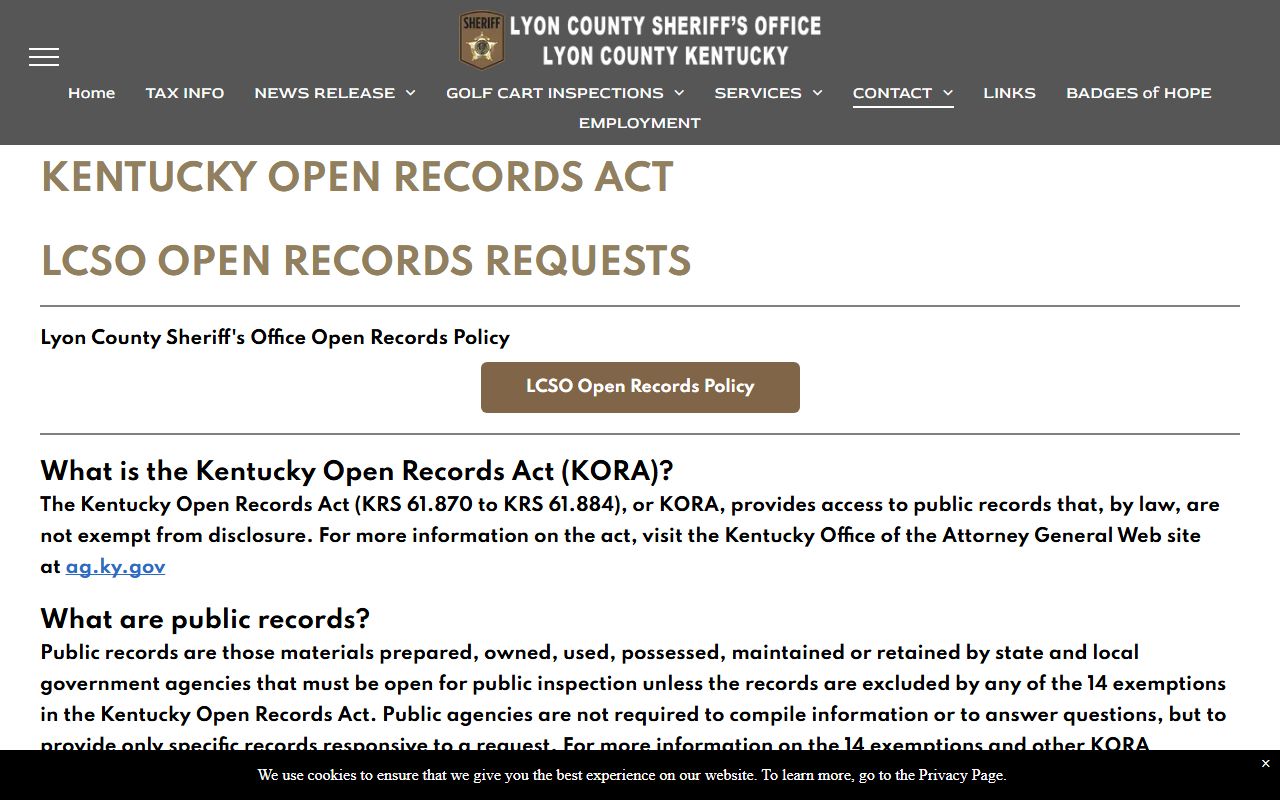
The Lyon County Sheriff's Office open-records page is the local fallback for sheriff records such as reports, accident records, and responsive law-enforcement materials. The request must be written and signed, print the requester's name, include address and phone number, and describe the requested records specifically by name, date, location, or other identifying detail. Submission channels listed in the research are mail, fax, or hand delivery to the LCSO Official Custodian.
The LCSO open-records request page gives the county law-enforcement request process, fees, and submission channels.
That LCSO process helps with sheriff-held records, but it does not create a promise of a public Lyon County jail roster or mugshot database.
Background Check Considerations
Arrest records and charge records can be incomplete if read without the final court outcome. A charge may be pending, dismissed, amended, or expunged. A sheriff report may be withheld in part if an exemption applies. A formal background check for employment, housing, credit, insurance, or another regulated purpose requires a compliant screening process rather than a casual court or sheriff lookup.
Important: Do not treat a Lyon County arrest entry as proof of conviction without the court disposition.
Restricted Charge Records in Lyon County
Juvenile records are restricted by Kentucky law and should not be presented as public charge lookups. Adoption, mental health, protected-party, medical, and safety-sensitive information may also be withheld or redacted. Body-worn camera or audio/video records can be restricted under KRS 61.168 in certain circumstances. Active investigation records may be limited under law-enforcement rules.
For a court charge that later qualifies for expungement, the person generally files in the county where the case was prosecuted. For Lyon County cases, the practical starting point is the Circuit Court Clerk. The requester should know the exact case number, charge, and disposition before selecting the correct Kentucky Court of Justice form.